A collaborative post from Sabrina Wu, EBCF, and Rebeca Rangel, Asset Funders Network. Read more about the event: Rooted and Rising: A Funder Convening on East Bay Small Business Resiliency and Regional Scale.
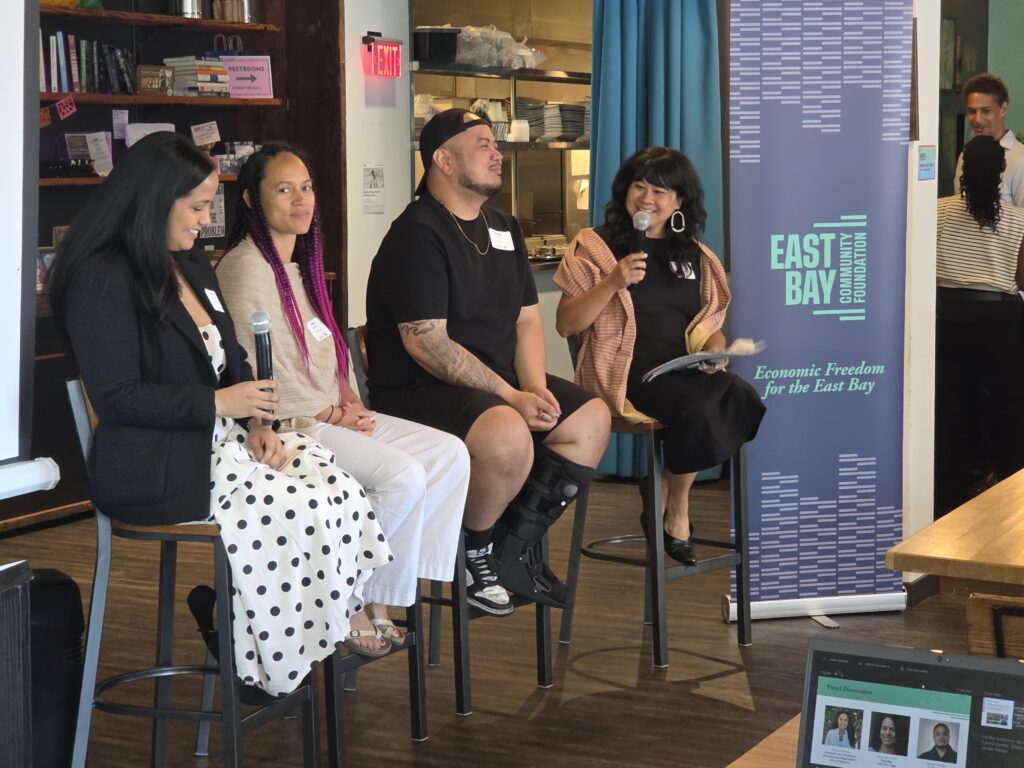
On May 21, 2026, small business funders and financial institutions gathered at Understory, a worker-owned cooperative restaurant in Oakland’s Fruitvale neighborhood, to consider the next chapter of the Oakland Small Business Resiliency Fund, built by East Bay Community Foundation (EBCF) in partnership with founding funder Kaiser Permanente, both long-time members of the Bay Area AFN chapter. The day’s throughline was a single idea: the most useful capital is the right form at the right moment—and for neighborhood businesses, that form is a grant, delivered through a community intermediary that opens the door for every funder to reach them.
When EBCF and Kaiser Permanente piloted the Fund, nearly 500 businesses applied, requesting more than $11 million. The Fund had $2.2 million and served 170 businesses. For funders, the instructive figure is not the $2.2 million that went out; it is the roughly $9 million in documented, vetted demand that did not—demand from small businesses that had already raised their hands, already articulated a need, already passed through a community-informed review. The question the pilot answered was not whether there is demand for this kind of capital in the East Bay. It is how much is going unmet—and what it would take, together, to meet more of it.
Why a Grant
The event opened where the foundation’s mission begins—with the conviction that everyone deserves the economic freedom to dream, heal, and belong. Most businesses start on “friends, family, and fools” funding: early, patient, non-debt capital that lets an owner take the first step or survive a hard season. Since the pandemic, a growing number of small businesses cannot or will not take on more debt. They are carrying the weight of the last few years, operating on thin margins, and a new liability is the opposite of resilience. A grant is the friends-and-family round these businesses never had—arriving late, and exactly on time.
Why an Intermediary
The second half of the thesis is operational. Most foundations are built to fund nonprofits; granting to for-profit businesses at volume, on a rapid-response timeline, in full compliance, requires machinery few institutions have had reason to build. For EBCF, the pilot meant leaning into its role as an intermediary in the ecosystem of partners supporting community-driven economic development—developing new systems to deliver a high volume of small grants to for-profit entities, quickly, while minimizing the hoops business owners had to jump through and keeping the foundation in legal compliance.
That infrastructure is an invitation. Any funder or financial institution that wants to reach these businesses can: EBCF aggregates capital, carries the administrative and compliance burden, and directs grants to documented low- and moderate-income neighborhoods—proven, place-based, and CRA-relevant. Partners bring the capital and the shared commitment; the pipeline is already built. This is what it looks like, in practice, to shift the flow of capital toward an inclusive, equitable, and regenerative economy that works for all.
The Businesses That Hold a Neighborhood Together
What the capital protects is specific and local. A throughline across the panel was that proximity is not incidental to this work—it is the work.
Soul Flow, a healing and yoga practice with locations in Oakland and Pinole, described how a single open door in a neglected stretch of downtown changes the block: people who didn’t know the space existed wander in, and a sense of possibility ripples outward.
Understory, our host for the event, launched in 2020 on a cooperative model—when the restaurant does well, its worker-owners do well. It nearly closed in transition before a Resiliency Fund grant helped it reopen in Fruitvale, where it has grown its team several times over and sustains a sliding-scale meal program open to anyone, regardless of ability to pay.
What’s Next
The pilot’s clearest lesson was that capital alone, while necessary, is not sufficient. Nearly every applicant said they also wanted advising, technical assistance, or training, and the pilot couldn’t always make those connections. The next iteration is designed differently: a redesigned, regional Fund that pairs grant capital with coordinated advising, technical assistance, and training as a single package of support—expanded into Alameda and Contra Costa counties, and built on the infrastructure the pilot proved.
The goal is to raise $5 million—more than double what the pilot deployed—to serve more businesses, in more places, more holistically. The Fund is one piece of EBCF’s broader strategy of entrepreneurship and business ownership as pathways to wealth-building. And there are several ways to be part of it: a funding partnership, thought partnership, or a connection to others in your network who should be at this table.
The gap the pilot revealed is still there. So is the proof that the right capital, in the right form, moved through the right intermediary, brings us closer to the East Bay we envision: one where everyone has the economic freedom to dream, heal, and belong.
Learn more or get involved:
- Join us at the Contra Costa Business Collaborative Forum on July 23 at Diablo Valley College in Pleasant Hill—an in-person convening, presented by EBCF in partnership with the California State Treasurer’s Office, on the expansion of this work in Contra Costa County.
- Oakland Small Business Resiliency Fund — East Bay Community Foundation
- Start a conversation: SmallBusinessResiliencyFund@eastbaycf.org
- Coverage in The Oaklandside and on ABC, CBS, and Telemundo.